I build the shared component libraries, UI standards and testing infrastructure other engineers depend on, as well as the customer-facing products that run on top of them. I work in React, Vue and TypeScript, usually in micro-frontend architectures, and across the full stack, with most of my depth on the frontend. Previously Thermo Fisher, Observe, Intuit, Raptr, Adobe and Walmart.com.
When a tool I rely on is missing something, I add it, either as a pull request upstream or as a project of my own. I write and maintain several open source projects: a React table component, a CLI on npm with a Claude Code plugin (over 30,000 downloads in the last year), and three Home Assistant integrations.
01Design systems and component libraries. Shared React and Vue libraries and UI standards used by internal teams and customers. Responsive down to mobile, accessible to WCAG and Section 508, and instrumented for real user monitoring (RUM) to capture detailed performance metrics in production.
02Automated testing and delivery infrastructure. Test tooling, CI/CD and quality gates that frontend teams ship through.
03Workflow orchestration. The interfaces internal teams and customers use to design, run and monitor multi-step workflows.
04Data-dense products. Dashboards and analytics views in React and D3, often split into micro-frontends with module federation.
05Early-stage product. Co-founding engineer at a startup, where I built the product from 0 to 1 as web, desktop and mobile apps.
06Domains. Fintech, martech, gaming, e-commerce, observability SaaS and life science analytical equipment.
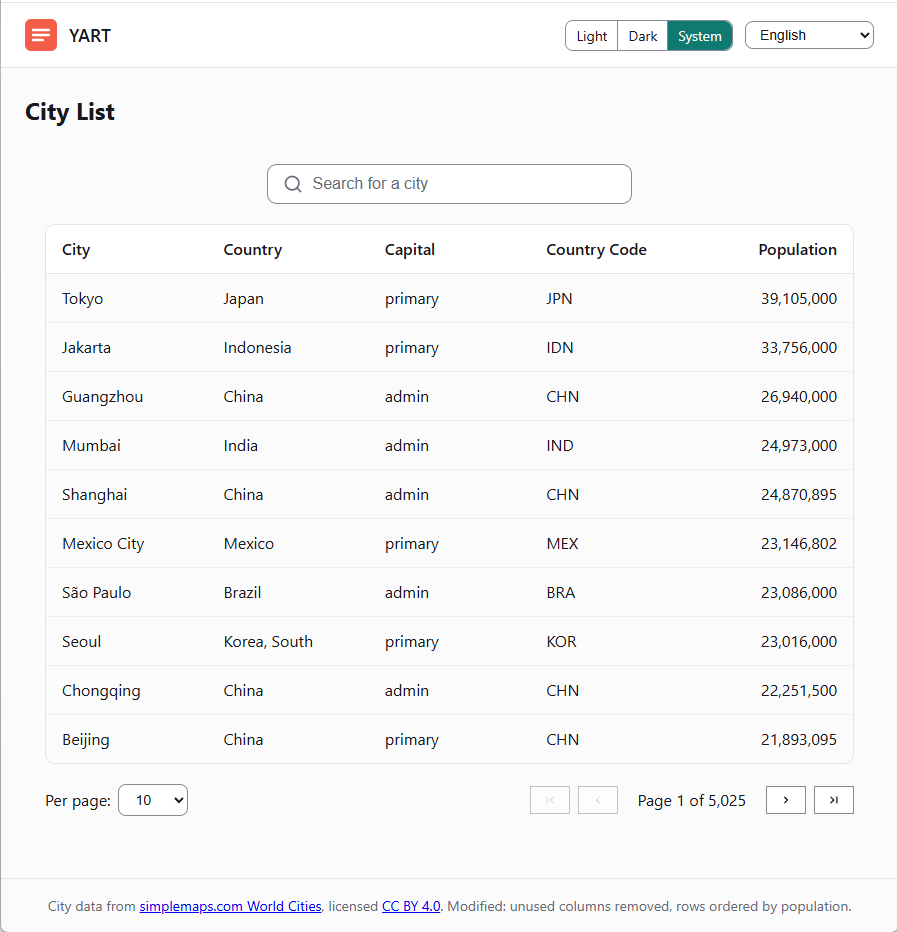
Search, sort and paginate large datasets in the browser with no table library.
I wanted to find out how far a hand-rolled data table gets, and to hold one to frontend best practices. It ships on npm with React as its only dependency, and the demo imports it through the same package entry a host app uses. It covers theming, internationalization and localization (including an RTL pseudo-locale), accessibility, and responsive layout down to mobile. View state lives in validated query parameters, so any view can be shared as a link. Axe sweeps run in a real browser across the loading, error, sorted and empty views, and Chromatic captures visual regression snapshots of eight view states, including the right-to-left locale, the empty result set and a second dataset. On every pull request, CodSpeed benchmarks the sort, paging and view-state code and Lighthouse audits page performance.
Built withType-checks the table, its locale and query-state logic with no any. · Renders the table, its controls and the search and pagination UI. · Scopes every component's styles so none leak across the page. · Shares one visually-hidden mixin for screen-reader-only text across modules. · Builds the themed stylesheet from DTCG JSON, so both themes share one source. · Resolves a stored or system locale across four catalogs, including an RTL pseudo-locale. · Sweeps the rendered app for accessibility violations in a real browser, including loading, error and empty views. · Runs the unit tests in jsdom and in a real browser, with 100% coverage. · Generates random inputs for the sort, paging and URL-state property tests. · Mutation-tests the table and its state logic to check the Vitest suite catches bugs. · Runs the end-to-end specs for search, sort, paging, theming and URL state. · Flags visual changes in eight view states, including dark theme, RTL and empty results. · Audits the built app in CI and posts median performance scores to each pull request. · Benchmarks sort, paging and view-state code on each pull request against the base branch. · Lints the TypeScript and JSX, with type-aware rules and accessibility checks.
npm CLI and Claude Code plugin · macOS, Linux, Windows
Latest release: v0.69.6 (Oct 2026) · 30,185 npm downloads in the last year
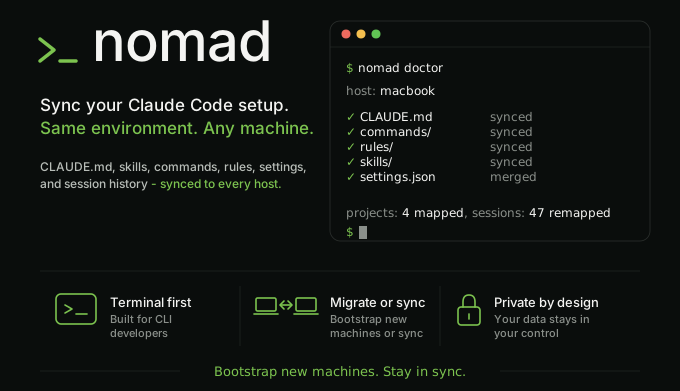
Syncs a full Claude Code setup across machines through a private Git repo you own.
It covers custom skills, slash commands, tuned settings and past conversations. I built it to keep my own desktop and laptop on the same Claude Code setup. It rewrites the machine-specific paths embedded in transcripts so history still loads when a project sits at a different path on each machine, and merges a shared settings base with per-host overrides. Before each push it scans the files about to sync with gitleaks and stops on any possible secret, with an interactive prompt to redact it, allow it or drop it. CI runs the test suites on Linux and Windows (macOS shares the Linux code paths), then generates the docs and publishes the npm release.
Built withType-checks the CLI, its sync engine and every command module. · Handles cross-platform file and path work, plus a Windows-only reconcile step. · Commits and pushes the synced files, and pulls with rebase to merge changes. · Runs the unit, integration and platform-parity test suites, with 100% coverage. · Mutation-tests the CLI's source incrementally to check the Vitest suite catches bugs. · Lints the CLI source, with SonarJS rules for bugs and cognitive complexity. · Scans staged files before push and prompts to redact, allow or drop secrets. · Builds the docs site published to GitHub Pages. · Lints the prose in the README, docs site and contributor guides.
Checks your smart home for problems and suggests fixes for you to approve.
Home Assistant is good at following the rules you set for your smart home, but it can't make judgment calls like whether something looks wrong. This integration uses TypeSafe AI's Jev model to review your smart home and flag what needs attention: devices that stopped responding, software updates that could break something, devices never assigned to a room, and sensors that don't say what they measure. Each suggestion shows how sure the model is. It skips anything the model is unsure about, and nothing changes until you approve it.
Built withImplements the whole integration, from the API client to its sensors and repair cards. · TypeSafe AI's system one model, used to judge each item and report how confident it is that there's an issue. · Backs off and retries a rate-limited or overloaded request without blocking Home Assistant. · Posts each batch of questions to the Jev API and checks the response shape. · Runs HA-fixture tests against Home Assistant itself, with code coverage held to 100%. · Mutation-tests the integration's source to check the pytest suite catches bugs. · Type-checks the integration in strict mode against Home Assistant's own stubs. · Lints and formats the integration's Python source.
Controls RainPoint Smart+ irrigation hardware and reports its status in Home Assistant.
I rebuilt an existing integration that did not have the test discipline I wanted. I reverse-engineered the RainPoint app's REST and MQTT traffic to get control and scheduling working. Unrecognized hardware triggers a notification that pre-fills a GitHub issue with the diagnostics I need. Requesting support for a new device takes a couple of clicks, and I can add devices I do not own with little back and forth.
Built withImplements the whole integration, from the RainPoint client to its entities. · Awaits one batched status call, falling back to per-hub calls without blocking. · Runs unit tests and HA-fixture integration tests, with code coverage held to 100%. · Mutation-tests the integration's source to check the suite catches bugs. · Lints and formats the integration's Python source. · Logs in and polls RainPoint's device and status endpoints. · Delivers real-time updates from the hubs instead of waiting for the next poll.
Imports hourly Alameda County Water District meter data into the Home Assistant Energy Dashboard.
I wrote it after the utility swapped my magnetic water meter for a smart one, and the Flume device I had tracked usage with for years could not read it. I tried intercepting the new meter's RF signal with a software-defined radio first, but it was encrypted, so I reverse-engineered the utility's REST API instead. The integration polls the API hourly, records long-term usage history, and can backfill any date range on demand.
Built withImplements the whole integration, from the login flow to the energy import. · Splits unit tests from HA-fixture integration tests by marker. · Mutation-tests the integration's source to check the pytest suite catches bugs. · Lints and formats the integration's Python source. · Signs in and pulls hourly meter data as JSON from the utility's API. · Parses the login page's HTML to pull the CSRF token.
01Lint and unit tests run before every commit and again in CI (ESLint, Prettier, Vitest, Ruff, Pytest).
02Integration tests run claude-nomad on Windows and Linux, the Home Assistant integrations against Home Assistant itself, and the web apps in a real browser (Playwright).
03YART runs visual regression tests (Chromatic) to catch UI changes nobody meant to make.
04Codecov enforces 100% code coverage.
05Mutation testing (StrykerJS, mutmut) plants small bugs on purpose and confirms the tests catch them.
This page runs on a small design system of its own. Color, type, spacing, radius and shadow come from one set of DTCG design tokens, which Style Dictionary compiles to CSS custom properties, and CSS resolves both themes from them so they cannot drift apart. A test rebuilds the tokens and fails if the committed CSS is out of date, and axe checks contrast in both themes in CI. Chromatic snapshots both themes at desktop and mobile widths for visual regression review on pull requests. The site is React 19 and TypeScript on Vite, prerendered to static HTML and deployed to Cloudflare Pages. The build generates llms.txt from the same data that renders the page.